If your cat “just stares” at a new toy without playing, it often stems from the toy’s design or interaction style conflicting with their natural hunting instincts and sensory preferences. Today, we explore 5 common cat toy mistakes and scientifically-backed solutions to reignite your cat’s play interest. Properly playing with your cat not only strengthens the human-cat bond but can also reduce destructive behaviors—making this a must-read for all cat parents.
Mistake 1: Toys with Repetitive Movements
Problem: Electric toys often follow fixed, predictable patterns (like bouncing fish), which fail to mimic the randomness of real prey. Wand toys swinging left-right or up-down become boring after 2–3 chases.
Solution: Follow the “16-character movement rule”: up-down, high-low, fast-slow, appear-disappear.
Simulate prey behaviors:
- Bird flight: quick upward jump followed by a gliding fall
- Snake movement: S-shaped motion across the floor
- Insect struggle: rapid small vibrations followed by sudden stillness
- Use props: Add tunnels, sofa gaps, or cardboard boxes along the toy path to create ambush points.
Mistake 2: Toys Made of “Anti-Cat” Materials
Typical issues: Oversized or heavy balls that cannot be batted, smooth plastic surfaces that lack grip, and strong artificial scents that overwhelm cats’ sensitive noses.
Ideal materials:
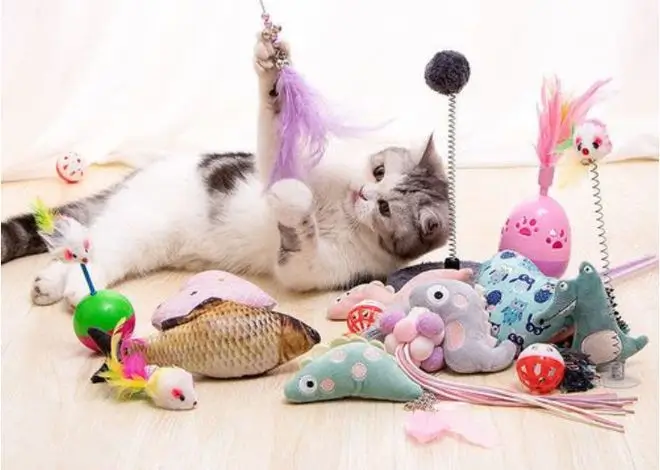
- Feathers or plush (5–10 cm) to mimic birds
- Corrugated cardboard or sisal for scratching (catnip optional)
- Bells or crinkly paper to trigger auditory hunting instincts
Test method: Place the toy on the floor—if the cat sniffs and paws at it for over 10 seconds, it passes the test.
Mistake 3: Prey That Can Never Be Caught
Laser pointers are a common trap: cats cannot achieve the satisfaction of “catching” prey, leading to frustration. Studies show 27% of cats playing exclusively with lasers develop anxiety and over-grooming behaviors.
Fix: After 30 seconds of laser play, guide the red dot to a tangible toy for your cat to pounce on. Reward with a treat to complete the hunting-eating cycle.
Mistake 4: Toys Always Left Out
Constantly visible toys become part of the environment, and cats lose interest within 2–3 days.
Rotation strategy:
- Divide toys into 3 sets, display only one set per week
- Store toys immediately after play (especially wand toys)
- Revive old toys: spray feather toys lightly with catnip or hide treats inside plush toys
Mistake 5: Ignoring Your Cat’s Individual Preferences
Age differences:
- Kittens: prefer fast-moving small toys like rolling balls
- Adult cats: enjoy strategic hunting toys such as track balls
- Senior cats: prefer slower, predictable toys like plush mice
Personality test: Observe hunting style:
- Ambush type: likes toys hidden behind obstacles
- Pursuit type: enjoys chasing long-distance targets
Test with 3 toy types: feather toys (airborne prey), plush balls (ground prey), and crinkle paper (auditory stimulation).
Ultimate Play Engagement: Environmental Enrichment
Multi-dimensional stimulation boosts play desire:
- Height differences: toss toys from cat trees to simulate diving birds
- Obstacle courses: use boxes and tunnels to create hunting zones
- Scent trails: mark toy paths with matatabi powder
Studies show that after environmental enrichment, 68% of cats regain interest in old toys.
Conclusion
Choosing toys that match your cat’s natural instincts and learning proper interactive techniques makes even a simple paper ball endlessly entertaining. Remember: toys are props—the owner is the ultimate “play engine.” Playing with you is what truly brings joy to your cat!